Need help with pricing, lead time, customization, compliance, or order concerns? Leave your details and our management team will contact you directly.

Why This RFID Laundry Tag Design Outperforms Standard Labels
Most labels die.
Not on day one, not in the vendor’s demo kit, and not while everyone is smiling through the kickoff call, but three months later—after alkali exposure, after extraction pressure, after tunnel wash, after the flatwork line starts chewing through volume, after the carts get overpacked, and after the plant realizes that “identification” in a brochure is not the same thing as identification in a live soil-to-clean loop.
And that’s where I frankly lose patience.
A standard label is passive in the worst way. It sits there. It fades, peels, or waits to be seen. An RFID laundry tag isn’t just a label with attitude; it’s an item-level identity that can keep showing up in reader events as linen moves through sort, wash, extraction, drying, finishing, storage, dispatch, and return. In healthcare settings, that distinction matters even more because CDC guidance still treats contaminated laundry as a controlled handling problem, and OSHA still requires contaminated laundry to be handled as little as possible, bagged or containerized at the location of use, and transported in labeled or color-coded bags or containers when required.
Static text. Live telemetry.
That’s the fight.
Table of Contents
Why standard labels feel cheap until they get expensive
But here’s the ugly truth: a lot of teams still buy laundry identification like they’re buying office supplies. They compare price-per-piece, glance at a survivability claim, nod at a sample, and miss the operational question completely—which is whether the tag survives chemistry, handling, compression, read-zone chaos, and the weird little workarounds that always appear on a real laundry floor.
That mistake is common.
And expensive.
Because the real comparison isn’t “printed label versus smart label.” It’s “manual visibility versus machine visibility.” UHF RFID in this category rides on the GS1 Gen2 / ISO 18000-63 framework, and that matters because the whole point is scalable item identification instead of line-of-sight dependence. The standard itself remains the backbone for this class of UHF systems.
You can feel the operational difference almost immediately. A printed label still wants someone to look at it—or at least present it to a scanner one item at a time. RFID doesn’t care about that ritual. It can be read in motion, in bunches, in portals, at issue/return points, at cage scans, in ugly dense loads where nobody has time for barcode ballet. That’s why I don’t treat RFID linen tracking as a cosmetic upgrade. In a serious plant, it’s a throughput tool. Sometimes a loss-control tool. Often both.
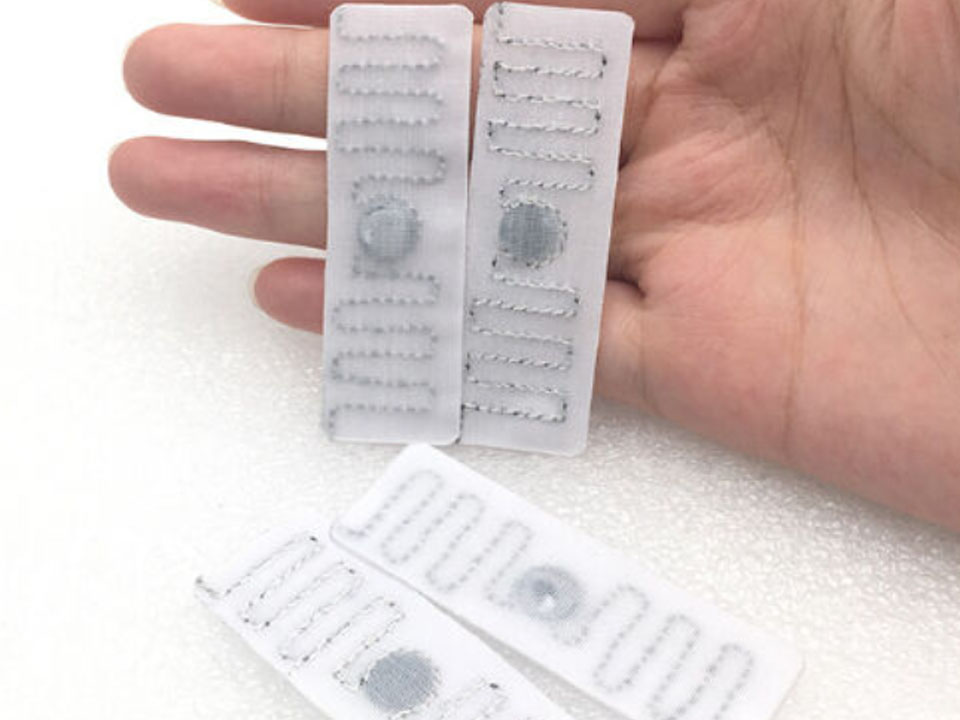
The tag doesn’t win by being “RFID”
It wins by fit.
That’s the part outsiders miss. They talk about the chip. I talk about the package around the chip—the textile substrate, the sew pattern, the profile, the placement, the flex behavior, the wash survivability, the read consistency when the linen is damp and stacked like concrete. Because from my experience, bad RFID projects usually don’t fail because “RFID doesn’t work.” They fail because the wrong tag got stuffed into the wrong textile workflow.
Soft textile formats usually beat rigid add-ons in wearables
If the item still has to behave like a garment, I don’t want a clunky solution pretending to be elegant. I want something that integrates cleanly and doesn’t become a complaint magnet for staff or a snag point in use. That’s why an industrial textile RFID tag for laundry tracking makes practical sense for reusable textiles, and why a sew-in textile RFID laundry tag for uniforms is the more believable option when comfort, concealment, and repeated garment handling all matter at once.
That’s not theory.
That’s shop-floor logic.
Heat-resistant fabric tags solve a different problem than button-style PPS
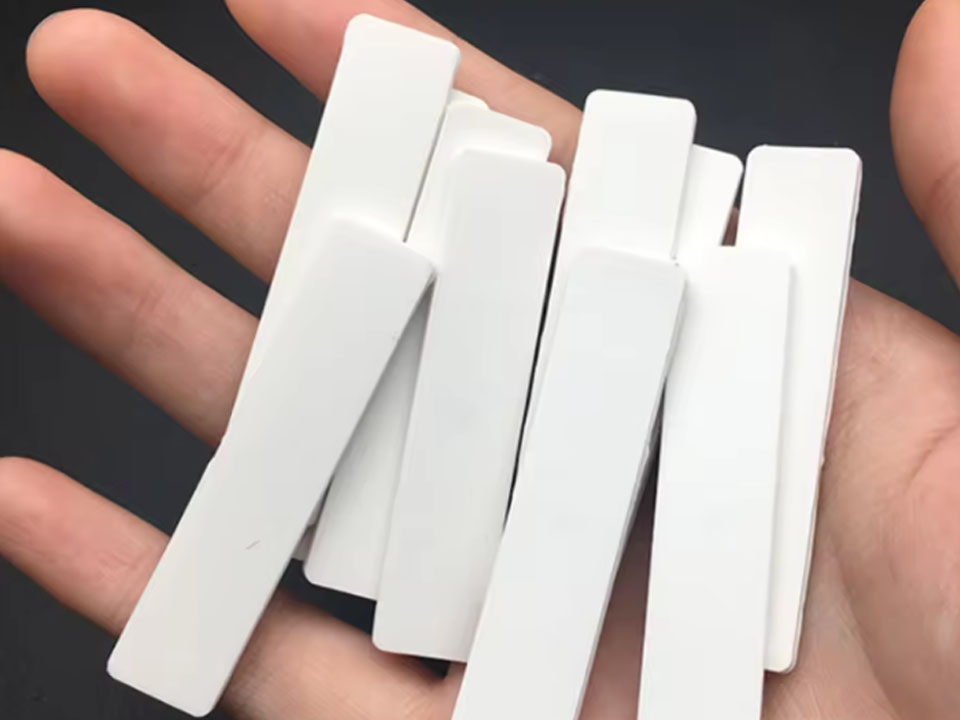
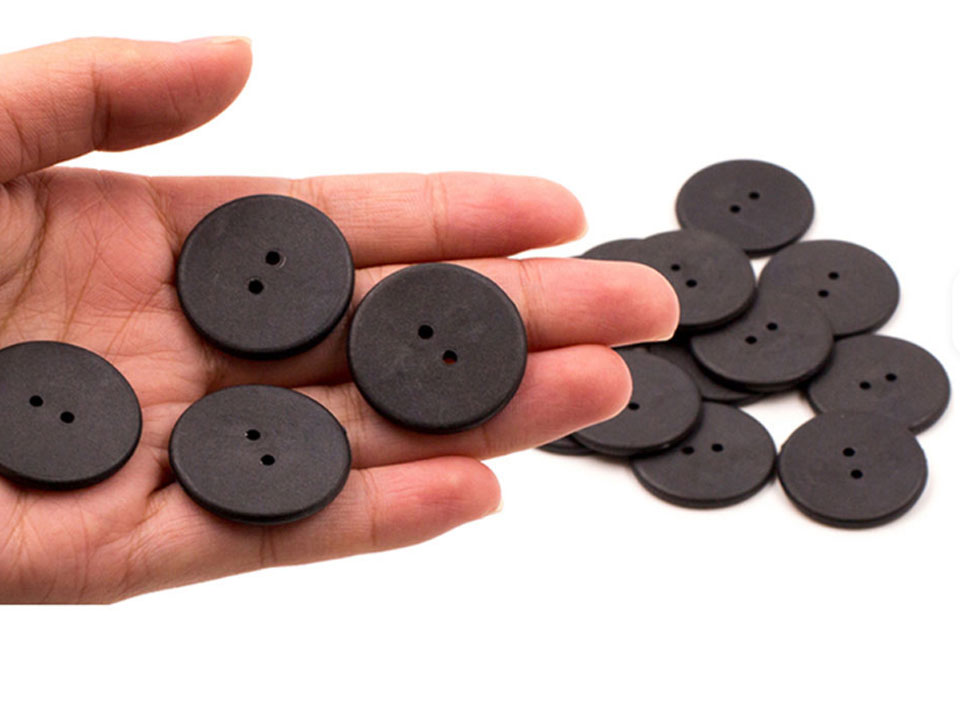
Yet soft isn’t always the answer. Some plants are rougher. Some finishing lines are mean. Some chemistry profiles are unforgiving. In those environments, I’d look hard at a heat-resistant fabric RFID tag for linen ID if I still want flexibility, and I’d absolutely consider a heat-resistant PPS laundry tag for linen ID when durability matters more than aesthetics.
That choice matters.
A lot.
Because once the tag starts living through repeated washings, water extraction presses, detergents, and high temperatures, design stops being a marketing word and becomes a survival test. That exact pattern shows up in real deployments: in the Les Lavandières de Provence case, HID LinTRAK tags powered by the Impinj M730 were sewn onto each linen piece, while readers including the Impinj R700 were installed at multiple points in the cycle to collect real-time data. The case study explicitly describes those tags as designed for dense environments and repeated washing, presses, detergents, and heat.
Dual-frequency isn’t a gimmick, but it isn’t mandatory either
And then there’s the architecture question—the one people usually leave until too late. Most industrial laundry RFID deployments are going to live in UHF land. Fine. But if the workflow needs broader checkpoint flexibility, or some combination of longer-range bulk ID and closer-range interaction, I wouldn’t dismiss a dual-frequency RFID laundry tag for linen tracking just because a simpler build looks cheaper on paper.
Paper lies.
Plants don’t.
RFID laundry tags vs standard labels when the line is actually moving
You learn this fast: labels are okay when the item is still, visible, and somebody has time. Laundry operations are the opposite. Things move. They bunch. They disappear into cages, chutes, conveyors, carts, and delivery loops. Somebody always thinks the count is right. Somebody is usually wrong.
Here’s the cleaner comparison:
| Decision Point | Standard Labels | Well-Designed RFID Laundry Tags |
|---|---|---|
| Identity model | Static text or barcode | Unique serialized item identity |
| Read method | Line-of-sight, often one by one | No line-of-sight, batch and portal reads |
| Throughput | Labor-bound | Reader-bound |
| Lifecycle tracking | Weak | Strong |
| Wash-count visibility | Manual or absent | Automatic if software is configured well |
| Best use case | Compliance, care info, basic SKU labeling | Reusable textiles, loss control, circulation visibility |
| Typical failure mode | Fade, peel, mismatch, missed scans | Bad placement, wrong substrate, poor read-zone design |
I’d put it even more bluntly. A standard label tells you what an item is supposed to be. RFID tells you where that exact item has been, where it is now, and—if the software isn’t garbage—when it starts behaving abnormally. That’s a different class of operational visibility. And yes, it changes how you manage shrink, rotation, service levels, and replacement timing.

The 2024 case studies aren’t subtle
I’m skeptical of vendor case studies by default. You should be too. But when three separate 2024 laundry or uniform stories keep hammering the same themes—less manual counting, tighter stock control, fewer mystery losses, better issue/return discipline, less paper nonsense—I pay attention.
Because patterns matter.
In Impinj’s May 2024 Nordland Hospital case study, the before-state was familiar: around 50,000 garments in circulation, weak visibility once items left shelves, and ongoing frustration around supply. After the RAIN RFID deployment, the hospital reduced inventory by 20,000 items, cut expected rental costs by €175,000 over 10 years, reduced textile waste by 3,500 items per year—about 70%—and moved to a 24/7 access model where employees could get uniforms without the old bottleneck. That’s not “nice to have.” That’s operational cleanup.
Then there’s Impinj’s February 2024 Les Lavandières de Provence case study. What jumps out to me isn’t the buzzwords—it’s the mechanics. Automated counting of hundreds of items in seconds. Less staff time wasted on manual counts. Item-level lifespan visibility. A clearer view of which specific pieces are at customer sites, in transit, or sitting in different zones of the laundry cycle. That’s where RFID garment tracking stops being “interesting” and starts becoming a control system.
And HID’s April 2024 Royal Jersey Laundry announcement is refreshingly blunt. The new feature replaced a paper-based system for managing clean and soiled linen cages, tracks end to end across washing, packing, delivery, and collection, and covers a process involving 550,000 pieces laundered each week. HID also says Royal Jersey operates 24/7, employs 150 staff, washes 40 tons of linen per day, and had already connected around 40% of hotel customers to the system, with cage scans done in seconds and reported labor savings of 10% to 20% plus linen expenditure reductions of up to 30%. That’s not hype language. That’s someone trying to get out of a paperwork swamp.
Why the label-only mindset is getting older by the month
Still, the strategic angle is bigger than laundry.
A lot bigger.
The textile industry is drifting toward richer digital identity, not flatter metadata. The European Parliament’s 2024 study on a textile digital product passport says a European DPP could improve traceability, circularity, and transparency in the sector, while the European Commission’s textile strategy explicitly lists the introduction of a Digital Product Passport alongside requirements intended to make textiles last longer and become easier to repair and recycle. So no—I’m not saying every commercial laundry operator needs to build for Brussels tomorrow morning. I am saying the market direction is obvious, and standard labels aren’t exactly getting smarter with age.
That matters for vendors too.
Because once serialized textile identity starts feeding compliance, service analytics, replacement logic, and even customer-facing transparency, the old “just sew in a label and count carefully” mindset starts to look less frugal and more outdated.
FAQs
What are RFID laundry tags?
RFID laundry tags are washable, serialized identifiers attached to reusable linens, garments, uniforms, or textiles so readers and software can identify each individual item throughout sorting, washing, drying, finishing, storage, delivery, and return without relying on line-of-sight scanning like ordinary labels or barcodes.
That’s why the technology changes operations. It doesn’t just mark the item. It creates an item-level event history when the system is set up properly.
How do RFID laundry tags work?
RFID laundry tags work by storing a unique identity on each textile item, which UHF readers capture automatically at checkpoints such as portals, issue-return stations, conveyor points, cage scans, or storage transitions, while software converts those reads into counts, location status, wash history, and exception alerts.
It sounds neat on paper. In reality, the trick is getting tag design, reader placement, and event logic to stop fighting each other.
Why do RFID laundry tags outperform standard labels?
RFID laundry tags outperform standard labels because they can identify items without line-of-sight, support high-volume batch reads, survive repeated laundry handling when properly designed, and generate item-level operational data that standard printed labels simply do not produce.
That’s the real gap. One shows static information. The other supports live process visibility.
What is the best RFID laundry tag for industrial laundry?
The best RFID laundry tag for industrial laundry is the one whose material, form factor, attachment method, and read behavior fit your textile type, wash chemistry, heat load, finishing process, and checkpoint architecture, because a technically decent RFID product can still fail badly inside the wrong laundry workflow.
From my experience, that’s where buyers get burned. They buy a spec. They really needed a fit-for-process design.
Are UHF RFID laundry tags suitable for healthcare laundry workflows?
UHF RFID laundry tags are suitable for healthcare laundry workflows when the tags are validated for the wash environment and the operation still complies with healthcare laundry handling requirements, because RFID improves visibility and control but does not replace CDC infection-control practices or OSHA handling rules for contaminated laundry.
That distinction matters. A tag helps you see better. It does not excuse sloppy handling.
Your next step
Don’t ask vendors for “an RFID solution.” That phrase is too soft. Ask them to prove read consistency in dense loads, survivability through your actual wash chemistry, performance after extraction and finishing, and software logic that turns reads into something more useful than raw noise.
Then make them line up the real contenders: a soft industrial textile RFID tag for laundry tracking, a flexible heat-resistant fabric RFID tag for linen ID, a tougher heat-resistant PPS laundry tag for linen ID, a garment-ready sew-in textile RFID laundry tag for uniforms, and—if the architecture calls for it—a dual-frequency RFID laundry tag for linen tracking.
Then test them where failures actually happen.
Wet bundles. Flatwork exits. Overstuffed cages. Dispatch scans. Return loops. That’s where the winner shows itself. Not in the sample box.